Un desglose de costos para compradores serios, escrito por alguien que ya construyó aquí.
Todo el que se pone serio con una propiedad en el Lago de Atitlán termina haciéndose la misma pregunta. Encontró un terreno que le encanta. Vio las casas existentes y se topó con muy pocas opciones, o con precios que parecen altos para lo que hay. Y empieza a preguntarse: ¿cuánto costaría construir? Saber cuánto podría costar construir es esencial para definir qué propiedad podría comprar a fin de cuentas y qué puede hacer con su presupuesto actual.
La pregunta es razonable. Las respuestas que circulan en internet no lo son.
La mayoría de las cifras publicadas sobre costos de construcción en Guatemala se sacan de promedios nacionales que no tienen nada que ver con construir en el lago. Las estimaciones típicas van de $400 a $700 por metro cuadrado. Para una construcción residencial de calidad en el Lago de Atitlán, debería estar contemplando entre $800 y $1,200 por metro cuadrado totalmente terminado. Algunos proyectos quedan por debajo de eso. Los terrenos en ladera con logística compleja, o los acabados de mayor especificación, lo superan.
Este artículo desglosa a dónde se va realmente el dinero, qué define el rango de costos y cómo se ve un proyecto real, con un caso de estudio de una obra recién terminada aquí en el lago.
Por qué el Lago de Atitlán cuesta más que el resto de Guatemala
Tres factores empujan los costos por encima de los promedios nacionales, y todos tienen que ver con la geografía.
Logística. La mayoría de los pueblos alrededor del lago no tienen acceso por carretera. Los materiales llegan en lancha, lo que suma costo, tiempo y coordinación en cada etapa del proyecto. Arena, grava, block, acero, madera, accesorios, electrodomésticos: todo viaja en lancha. En un terreno en ladera, los materiales que llegan en lancha luego suben a mano por la pendiente. Ese trabajo se acumula.
Mercado laboral. La mano de obra calificada es genuinamente buena en el lago. Los albañiles, carpinteros y herreros locales tienen experiencia con los retos específicos de construir sobre terreno volcánico. Pero la fuerza laboral calificada no es infinita, y la demanda de proyectos de extranjeros y desarrolladores ha subido los salarios de forma notable en los últimos cinco años.
Sobrecosto de transporte de materiales. Ciertos materiales simplemente cuestan más en el lago que en la Ciudad de Guatemala o Antigua. Todo lo frágil, voluminoso o pesado carga un sobrecosto logístico que puede sumar del 15 al 25 por ciento al precio de entrega frente a un sitio con acceso para camión.
Los componentes del costo: qué está pagando realmente
| Categoría de costo | Rango típico | Variables clave |
|---|---|---|
| Diseño y arquitectura | 8–12% del costo de construcción | Complejidad, requisitos de ingeniería estructural |
| Permisos y aprobaciones | Q5,000 a Q15,000 | Municipalidad, evaluación ambiental, los tiempos varían mucho pero contemple 6 meses en promedio |
| Estructura y obra gris | 35–40% del total | Tipo de material (block de concreto vs. estructura de acero), acceso al sitio |
| Eléctrico y plomería | 15–20% del total | Solar vs. red, sistema de agua, gas propano vs. eléctrico |
| Acabados (interiores) | 20–30% del total | Calidad de azulejo, ebanistería, accesorios, materiales importados |
| Sobrecosto logístico | 10–20% sobre materiales | Acceso al pueblo, ladera vs. orilla del lago, distancia desde Panajachel |
| Imprevistos | 10–15% del total | Esencial en el lago. No se lo salte. |
La línea de imprevistos no es opcional. El clima, los atrasos en suministros, las revisiones de permisos y diseño, la escasez de materiales y las sorpresas del sitio son parte de construir en el lago. Presupuéstelos antes de empezar, no después de que ocurran.
Permisos: el paso que la mayoría de los compradores subestima
Los permisos tardan más en el lago de lo que la mayoría de los compradores espera, y los requisitos son más enredados de lo que aparentan. Una construcción residencial en una municipalidad guatemalteca fuera de la zona del lago podría pasar la revisión municipal en pocas semanas. Por lo general se construye por derecho, aunque aplican algunas exclusiones, y es esencial tener la documentación correcta en la solicitud del permiso. La mayoría de las municipalidades tiene una sola persona responsable de los permisos junto con muchas otras tareas, así que planifique en consecuencia. Un proyecto en el Lago de Atitlán suele requerir:
- Permiso municipal de construcción (USI en Santa Cruz La Laguna y los alrededores)
- Aprobación de drenaje y tratamiento de aguas
- Documentación de la fuente de agua
- Evaluación de riesgo de deslizamiento e incendio (para terrenos en ladera)
- Documentos de propiedad y registro de NIT/RTU
Presupueste de Q5,000 a Q15,000 en tarifas de permisos ($650 a $2,000 USD) según la escala del proyecto y la municipalidad. Más importante aún, contemple de veinticuatro a treinta y dos semanas de trámite de permisos antes de esperar empezar la obra. Empezar el trámite tarde es la causa más común de atrasos que vemos en los proyectos. El período de permisos también es productivo: aprovéchelo para afinar el diseño y los detalles de construcción, entrevistar a los subcontratistas clave y conseguir materiales con tiempos de entrega largos.
Un proyecto real: Estudio Sibaque
Los números se vuelven útiles cuando están atados a una construcción real. El Estudio Sibaque es un estudio residencial compacto terminado en Panajachel en 2024, diseñado por Andrea Castillo de De Adobe Architecture, la principal firma integrada de diseño y construcción del lago.
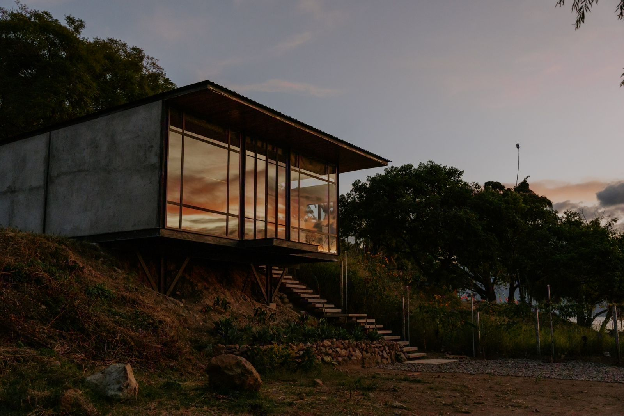
Exterior del Estudio Sibaque al atardecer. Construcción con estructura de acero en un terreno inclinado de Panajachel.
| Detalle del proyecto | Estudio Sibaque |
|---|---|
| Ubicación | Panajachel (terreno con acceso para camión) |
| Construido | 2024 |
| Tamaño | Aproximadamente 65 m² de área construida |
| Sistema estructural | Estructura de acero en terreno inclinado |
| Costo de construcción | $65,000 USD (incluye sistema solar y de agua caliente) |
| Mobiliario | $10,000 USD |
| Total todo incluido | $75,000 USD |
| Costo por m² (construcción) | ~$1,000 USD / m² |
| Tiempo de obra | 10 meses |
| Tiempo de permisos | Aproximadamente 6 meses |
| Sistema de energía | Totalmente solar fuera de la red (fotovoltaico + agua caliente solar) |
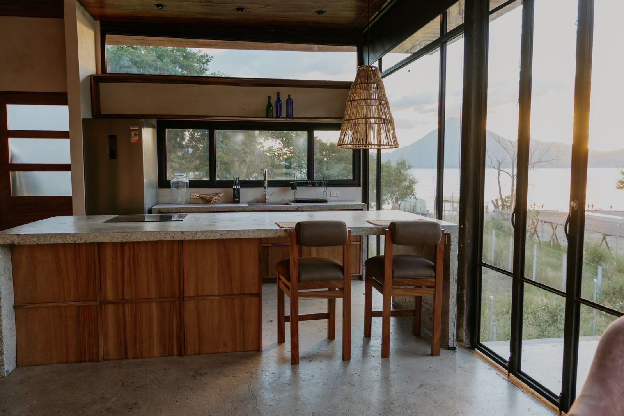
Interior con vista hacia el lago. Cocina y sala del Estudio Sibaque.
¿Por qué acero en lugar de block de concreto?
La decisión se redujo al sitio. El terreno está en ladera y queda cerca de un río, lo que crea tres problemas prácticos para la construcción convencional de block de concreto: es más difícil de construir estructuralmente, la excavación y el encofrado en pendiente suman costo y tiempo considerables, y la cercanía al agua hace que la elevación del piso sea una verdadera consideración.
La estructura de acero resolvió los tres. Permitió que la construcción quedara en voladizo sobre la pendiente, lo que se convirtió a la vez en un rasgo arquitectónico y en una solución de ingeniería. También ganó dos metros de elevación, lo que significa que el agua corre libremente por debajo en caso de una inundación. Y redujo el tiempo de obra: el armado de la estructura de acero avanza más rápido que el block de concreto, lo que contribuyó a terminar en diez meses en lugar de los catorce a dieciocho que probablemente requeriría una obra de block en un terreno similar.
Para los compradores que evalúan terrenos en ladera en el lago, y la mayoría de los terrenos deseables aquí están en ladera, vale la pena pensar la decisión del material estructural desde temprano. No es necesariamente una decisión estética. Es una decisión de ingeniería y de calendario, y tomarla tarde cuesta dinero.
"Este espacio ha sido mi maestro."
— Andrea Castillo, Principal, De Adobe Architecture
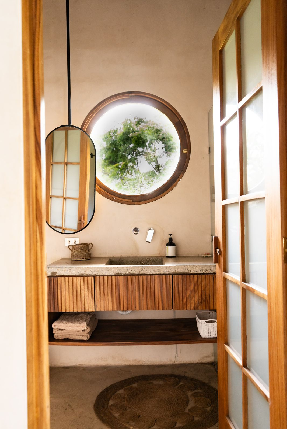
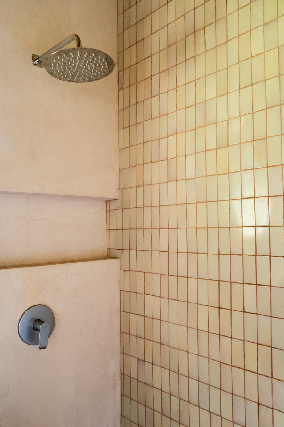
Detalles del baño, Estudio Sibaque. Acabado en piedra volcánica.
Una nota sobre el acceso al sitio y el sobrecosto
El Estudio Sibaque está en un terreno con acceso para camión en Panajachel. El mismo estudio en una ladera que requiere acceso por lancha y manejo manual de materiales empujaría el costo todo incluido hacia $88,000 a $92,000 con los sobrecostos logísticos actuales. Eso es un aumento del 17 al 22 por ciento impulsado por completo por el sitio, no por el diseño ni la calidad de los acabados.
El acceso al sitio es una de las primeras preguntas que hay que hacer al evaluar cualquier terreno en el lago. No siempre es el factor decisivo, pero tiene que estar en el modelo de costos desde el primer día.
Cómo se ven las cuentas de la inversión
Construir en el lago no siempre sale más barato que comprar algo ya existente. Para los compradores que comparan un presupuesto de obra con el precio de venta de una casa existente en una ubicación similar, los números a menudo los sorprenden.
Lo que ofrece construir es otra cosa: un producto terminado, diseñado para su uso, su sitio y su programa, sobre una tierra que eligió por las razones que le importan. Las obras bien ejecutadas en el lago también cargan un sobreprecio de reventa frente a las construcciones más antiguas, sobre todo cuando el diseño es arquitectónicamente distintivo y los sistemas (energía, agua, estructura) están bien hechos.
El rango práctico para una construcción residencial de calidad en el Lago de Atitlán en 2026 va de $800 a $1,200 por metro cuadrado según la ubicación, el acceso al sitio, el sistema estructural, el nivel de acabado y los sistemas de energía. Para proyectos más pequeños (de menos de 100 m²), el costo por metro cuadrado tiende al extremo alto porque los costos fijos de diseño, permisos y logística se reparten sobre menos área. Una casa grande tiene la misma cantidad de cocinas que una pequeña, y por lo general solo uno o dos baños adicionales.
Los costos de obra en el lago premian a los compradores que hacen su tarea temprano. Las decisiones tomadas antes de empezar la obra, sobre el sitio, la estructura y los sistemas, determinan el número final más que cualquier cosa que pase durante la construcción.
¿Pensando en construir? Empiece por el sitio.
Si está evaluando tierra en el Lago de Atitlán con la intención de construir, la decisión de compra y la planificación de la obra deberían ir de la mano. El acceso al sitio, la orientación del terreno, la jurisdicción municipal y el estatus OCRET afectan lo que puede construir y cuánto va a costar. Trabajamos tanto en corretaje como en diseño y construcción para asegurarnos de que los compradores entiendan ambos lados de esa ecuación antes de comprometerse.
Aplique al Programa VIP para Compradores o escríbanos directamente para conversar sobre su proyecto.