The honest, specific answer to what it costs to build at Lake Atitlán — accounting for the terrain, logistics, labor market, and regulatory environment. This has never been written down in English. Until now.
Everyone who gets serious about property at Lake Atitlán eventually asks the same question. They've found a lot they love. They've run the numbers on buying an existing home. And then someone tells them: "You could just build."
What follows is usually a string of Google searches that return construction cost figures for Guatemala City, a few expat forum posts from 2017, and nothing that actually answers the question. The honest, specific answer — what it costs to build at the lake, accounting for the terrain, the logistics, the labor market, and the regulatory environment — has never been written down in English.
Until now.
Build cost Lake Atitlán is not the same number as build cost Guatemala. Not even close. Here's what the numbers actually look like.
Why Every Figure You've Found Online Is Wrong for This Market
Guatemala's published construction cost data is almost entirely urban. The figures cited by real estate aggregators — $500 to $1,000 per square meter for mid-range construction — reflect building in Guatemala City, Antigua, or Quetzaltenango. Flat lots. Road access. Materials delivered by truck. Labor sourced from a large local pool.
None of those conditions apply at Lake Atitlán.
The lake sits in a volcanic caldera at 1,560 meters elevation, ringed by steep terrain, served by a road system that doesn't reach several of the most desirable villages, and accessible in many areas only by boat. Every single factor that drives construction cost in a standard market — site access, materials logistics, skilled labor availability, slope and foundation conditions — behaves differently here than anywhere else in Guatemala.
The buyer who arrives with a national cost figure and applies it to a lot in Tzunuña or Santa Cruz will be in for a significant surprise. The buyer who understands the real cost structure from the beginning builds a better project and makes a better land acquisition decision.
The Three Build Tiers at Lake Atitlán
Construction cost Guatemala figures typically describe one or two quality levels. At the lake, there are three meaningfully distinct tiers, each reflecting a different buyer profile and finish standard.
Basic / Local Construction: $400–$800/m²
This is concrete block construction with local materials, lamina roofing, standard Guatemalan electrical and plumbing, and basic finish work. It's the tier at which most local Guatemalan homes are built and the entry point for foreign buyers on tighter budgets. At the lower end of this range, you're getting a structurally sound, functional home with modest finishes. At the upper end, you're getting something with a bit more attention to detail — better tile work, nicer fixtures, a more considered layout.
What you are not getting at this tier: imported materials, high-performance systems, design-driven architecture, or the kind of finish quality that a discerning international buyer would expect in a retreat or rental property.
Mid-Range / Expat Quality: $800–$1,200/m²
This is the most common tier for foreign buyers building a primary residence, a rental home, or a boutique guesthouse. It includes better-quality local and regional materials, professional architectural input, proper structural engineering for sloped sites, upgraded electrical systems, a biodigestor and septic system for flush waste water, and finish work that meets international expectations. This is where most well-executed expat builds land.
At $1,000/m² — the middle of this range — a 100m² home represents a $100,000 construction investment before land, site work, permits, or furnishing. That number is real and should be used as a planning anchor.
High-Spec / Retreat-Level: $1,200–$2,000/m²
This tier covers imported finishes, custom joinery, high-performance systems (solar, water filtration, passive cooling), infinity pools, natural material construction (bamboo, adobe, volcanic stone), and the level of architectural and interior finish quality expected in a boutique wellness retreat or high-end short-term rental. At the upper end of this range, you are competing with the best-built properties at the lake. Several properties have been built and operated at this standard, and the rental and resale premiums justify the investment for the right buyer.
Sample Project Buildup: Estudio Sibaque, Panajachel
Not every high-spec build at Lake Atitlán takes two years and a large crew. Estudio Sibaque, a 55m² studio designed and built by De Adobe Architecture in Panajachel, is one of the more instructive examples of what intentional design, smart structural decisions, and tight execution can produce at the lake.
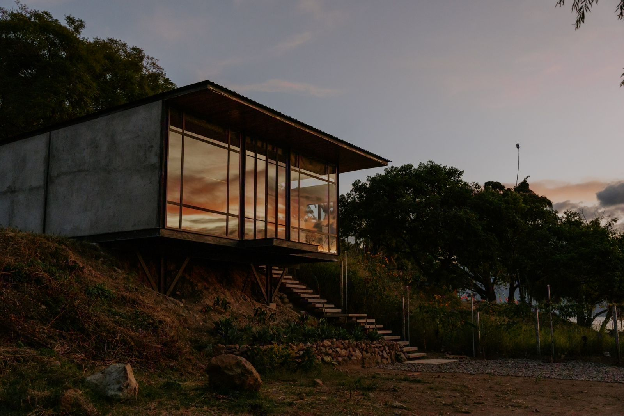
Full steel frame, hillside site, floor to ceiling windows.
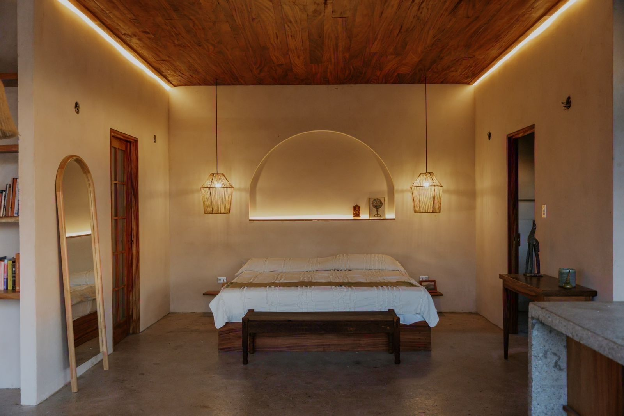
Studio bedroom with wood ceilings, polished concrete floors, and well appointed interior lighting.
| Size | 64 m² |
| Construction + renewable energy | $80,000 |
| Furnishings | $8,000 |
| Total all-in | $88,000 |
| Cost per m² (fully furnished) | ~$1,375/m² |
| Build timeline | 10 months |
| Permit timeline | 4 months |
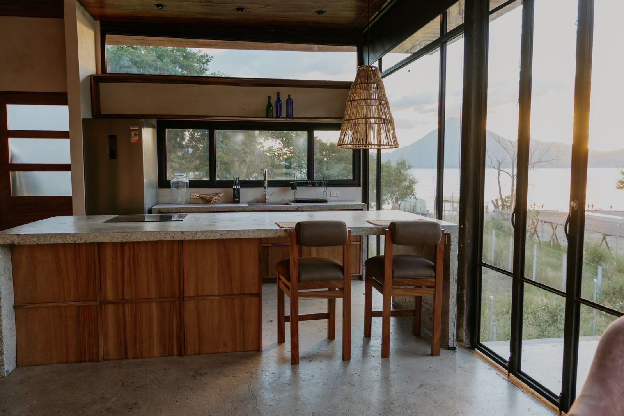
Kitchen with floor-to-ceiling steel windows, lake view, concrete island, teak cabinetry.
The structure uses a steel frame with polished concrete floors, a lamina roof, and floor-to-ceiling steel-framed windows that open the interior entirely to lake and volcano views. The project is fully off-grid — solar photovoltaic for power and a solar hot water system — which eliminates dependence on the grid infrastructure that remains unreliable in parts of the lake basin.
Why Steel?
The choice of steel frame over conventional concrete block construction was deliberate and site-specific. Steel allowed the structure to cantilever off the sloped lot — providing both a dramatic architectural gesture and a practical solution to the high-point exposure that comes with hillside sites prone to storm hazard. It also compressed the build timeline significantly: steel frame assembly moves faster than concrete block construction, which contributed directly to completing the project in ten months rather than the fourteen to eighteen months a comparable concrete build might require.
For buyers evaluating sloped lots — which describes most of the desirable land at the lake — the structural material decision is not an aesthetic choice. It is an engineering and scheduling decision that should be made as early as possible in the design process, ideally before the lot is purchased.
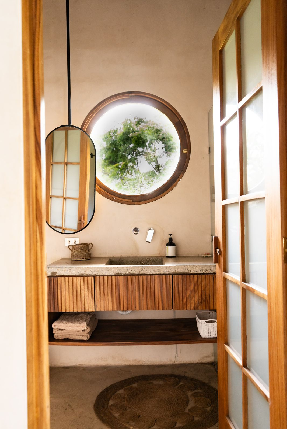
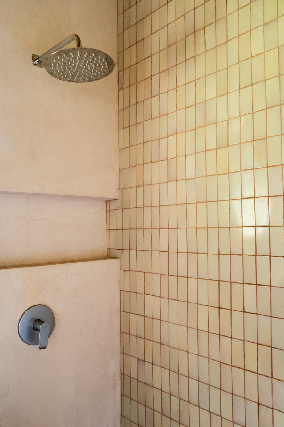
Bathroom with circular window, concrete vanity and shower with floor to ceiling tile.
"This space has been my teacher."
— Andrea Castillo, Principal, De Adobe Architecture
A note on this example's place in the cost tiers: Estudio Sibaque lands at the high end of high-spec on a truck-accessible Panajachel site. The same studio on a hillside requiring boat access and manual material handling would push the all-in cost toward $88,000–$92,000 at current logistics premiums — a 17–22% increase driven entirely by site, not design.
The short-term rental market rewards good design. Estudio Sibaque lists on Airbnb at above $100 per night and is frequently booked two to three months in advance. A premium rental like this holds occupancy through low season and commands both strong pricing and high occupancy when high season arrives — a combination that most properties at the lake can't replicate.
The Hidden Cost Categories Nobody Budgets For
This is where Lake Atitlán construction diverges most sharply from buyer expectations. The following categories rarely appear in an architect's preliminary budget. They should be the first line items on yours.
Material Handling: The Cost Nobody Talks About
There is a hidden cost in nearly every Atitlán build that contractors often miss and architects almost never budget for: the full logistics chain from purchase point to jobsite.
Ask yourself: How far is your property from a ferretería? How far is it from the road? How far up a path does material need to be carried — on someone's back?
Due to the terrain surrounding the lake, materials cannot be moved by machine on most sites. They are carried by hand, up steep paths, from boat docks, in increments. This is not a minor inefficiency. It is a fundamental cost driver.
A bag of sand in Panajachel costs approximately Q200. The same bag of sand in Tzunuña costs Q600 — three times as much — by the time it has traveled by lancha and then by human labor to the site. A cubic meter of sand costs about Q350; to haul that up to a jobsite 200 meters from a drop-off point will cost about Q720. The hauling of this heavy material is nearly twice the cost of the material bought off the shelf. Multiply that across every bag of cement, every block, every beam, every roll of electrical wire, and the impact on total project cost is substantial.
As a planning rule: for boat-access sites on the north shore, budget a 20–50% premium on materials costs alone, depending on proximity to the dock and the slope between the dock and your site. This range is not an estimate — it reflects real project experience at the lake.
Site Work and Slope
Volcanic caldera terrain means steep lots, and steep lots mean costs that flat-site buyers never encounter. Most buildings at the lake are constructed on cut platforms — the hillside is carved to create a level building pad, with retaining walls holding the slope above and below.
The cost of this work varies enormously based on one critical known unknown variable: how many meters of soil before hitting solid rock. Soil cuts with machinery are manageable. Rock cuts require equipment that often has to be brought to the site by boat and operated in tight conditions.
Retaining walls at the lake are not incidental. For significant slope differentials, retaining wall costs alone have exceeded $80,000 on real projects. This is not a contingency item — it is a first-order budget question that should be asked before any lot is purchased.
Skilled Labor Sourcing
Local Guatemalan labor rates are genuinely low by international standards, and this is a real advantage for building at the lake. However, the labor pool for skilled trades — licensed electricians, plumbers, experienced tile setters, finish carpenters, structural engineers — is thin on the ground locally.
The best skilled tradespeople who grew up around the lake are, in large numbers, working in the United States. What remains locally is often adequate for basic work but insufficient for mid-range and high-spec builds. The result: skilled trades are typically sourced from Sololá, Xela, Guatemala City, or kept on retainer by local contractors — which means not just wage costs, but travel time, accommodation, and the management complexity of a workforce that isn't local.
Budget accordingly, and engage your contractor in a direct conversation about where their skilled trades actually come from.
Permitting: The Line Item That Becomes a Crisis
Municipal permits around Lake Atitlán run approximately $800–$2,000 — a manageable cost in the context of a full project budget. What makes permitting consequential is not the fee. It is the time and the consequence of skipping it.
Building at the lake is by right — a properly designed project on appropriately zoned land is not at risk of being denied. What the permit process does is ensure the project meets minimum standards for drainage, water treatment, and site safety, and that the relevant municipality receives its fee. Local authorities are not adversarial. They want to know that your build won't harm your neighbors or the lake. Working through the process properly is how you demonstrate that.
That said, a proper permit in this environment takes 4 to 10 months to obtain, depending on the municipality. Many foreign buyers, impatient to begin construction, skip this step or work around it with informal arrangements. Guatemalan authorities can and do stop construction on unpermitted projects. When that happens, it costs more than money — it costs momentum, contractor continuity, weather windows, and the goodwill of local relationships that are hard to rebuild.
What does a permit submission actually require? Requirements vary by municipality, so always confirm with the relevant local authority — but a reliable planning checklist includes: general plans showing drainage, water treatment, water source, and an evaluation of site-specific risks such as landslides or fire. On the legal documentation side, you will typically need to demonstrate land ownership, identify the owner or Sociedad Anónima, provide a NIT or RTU number, and — in Santa Cruz specifically — a USI, which is the local municipal tax identification.
The right approach: budget the permit fee, build the permit timeline into your project schedule from day one, and treat it as non-negotiable.
What This Means for Your Investment Math
The question buyers should be asking is not "what does it cost to build?" in isolation. It is: does it make more sense to build or to buy?
At the lake, the answer depends on what you're trying to achieve.
Buying an existing, well-built property with clear title and professional construction in a desirable location carries a premium — but it eliminates the construction risk, the logistics management, the 12–24 month build timeline, and the accumulated decisions that turn a well-intentioned project into a cost overrun. For buyers who want to be at the lake living and generating income, buying existing is often the faster, lower-risk path. However, with that you inherit the building's design flaws — seen and unseen.
Building makes sense when the right lot exists in a location where no suitable built property is available, when the buyer has the time and tolerance for a construction project, and — critically — when they are working with a team that understands the real cost structure from the beginning. The worst outcomes at the lake come from buyers who underbudget based on national figures, start building, and run out of capital before the roof is on.
The best outcomes come from buyers who treated the land acquisition and the construction budget as a single decision — because they are. This is not meant to discourage building. Going through the process, you get a tailor-made home built to your preferences, and that carries a real resale premium: each new build replaces an era of more limited finish availability, and the market recognizes it.
Working With a Broker Who Understands Construction From Day One
At Atitlan Properties, we work across brokerage and with a design-build approach. That means when we're evaluating a lot with you, we're simultaneously thinking about what it will cost to build on it — the access logistics, the slope, the retaining wall exposure, the municipal jurisdiction, the materials chain to that specific site.
That context changes which lots make sense to buy, what price is justified, and what your all-in budget needs to look like before you commit to anything.
Contact us to discuss your project — whether you're evaluating land, planning a build, or trying to understand whether buying or building makes more sense for your goals.