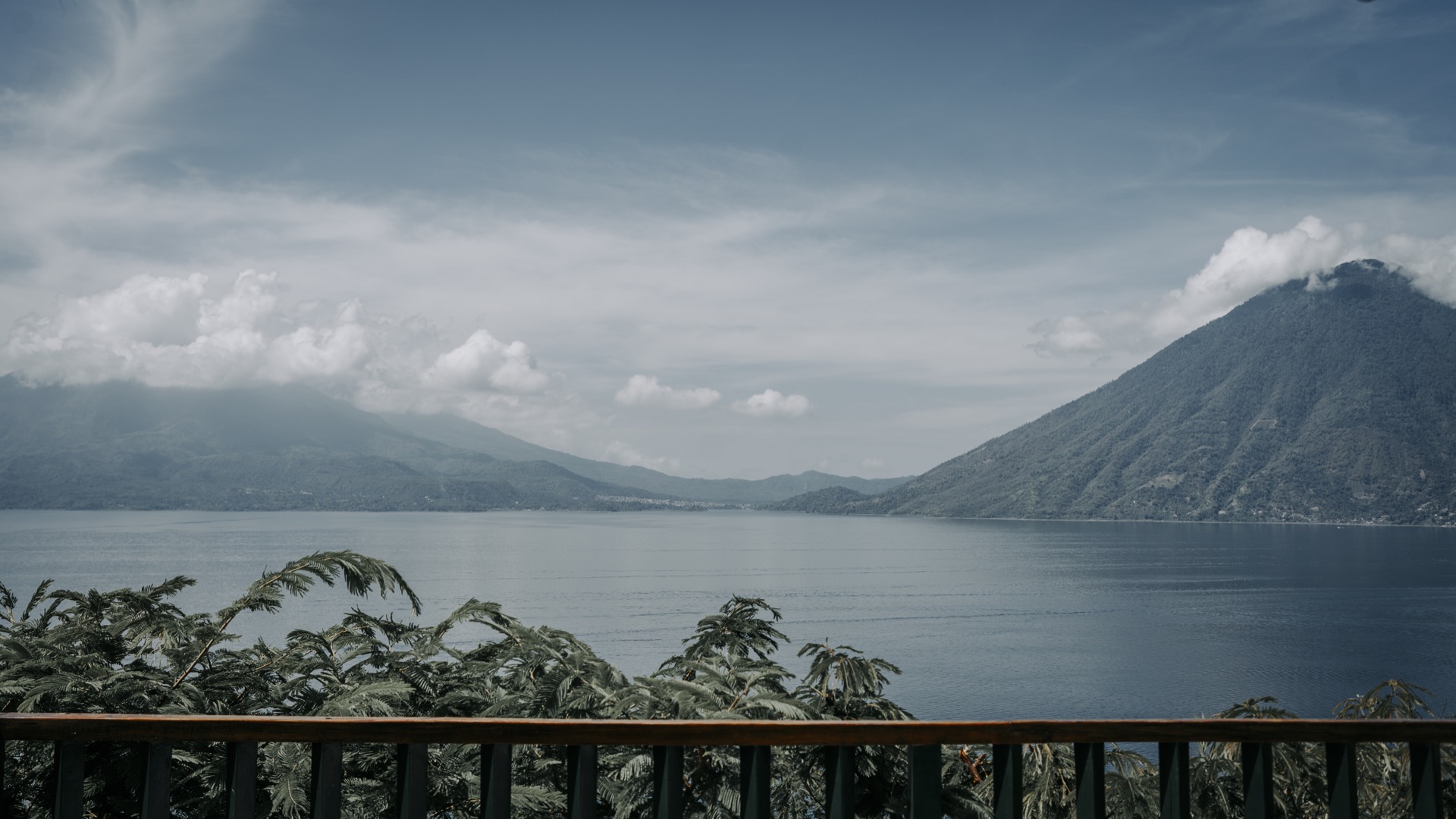
This post explains OCRET in plain terms, what it means in practice for buying waterfront property at Lake Atitlán, and gives you a clear framework to evaluate any OCRET-encumbered property — or know when to walk away.
You have found a stunning property at Lake Atitlán. Lakefront terrace, mature tropical gardens, maybe a private dock sloping to the water. Then your attorney mentions the word OCRET, and the questions start piling up: Is this land owned or leased? Can I, as a foreigner, actually hold this? What happens if the prior owner never paid the fees? Will this affect my resale?
These are exactly the right questions to ask. The problem is that most buyers do not know to ask them until they are already deep in a deal. This post explains OCRET in plain terms, tells you what it means in practice for buying waterfront property at Lake Atitlán, and gives you a clear framework to evaluate any OCRET-encumbered property — or know when to walk away.
What Is OCRET?
OCRET stands for Oficina de Control de Areas de Reserva del Estado — the Office of Control of State Reserve Areas. It is the Guatemalan government body, operating under the Ministry of Agriculture (MAGA), that administers a legally protected strip of land surrounding the country's lakes, rivers, ocean coastlines, and water sources.
The legal foundation is Article 122 of Guatemala's Constitution, which reserves state dominion over a 200-meter band of land measured from the shoreline of all lakes. At Lake Atitlán, this means that the land within 200 meters of the waterline belongs to the Guatemalan state. Private parties can occupy and use this land, but only through a formal OCRET lease contract (contrato de arrendamiento).
Decreto 126-97 is the implementing legislation that created OCRET and governs the leasing process. A new regulation — Acuerdo Gubernativo 151-2024 — took effect on October 1, 2024, replacing rules that dated to 2002. This updated regulation modernized administrative procedures and introduced digital filing options, so any information predating October 2024 may no longer reflect current process. If you have read about OCRET on other real estate sites, check the date: much of what circulates online is a decade old.
Here is something that surprises most buyers: while properties within the 200-meter zone are legally expected to hold an OCRET lease, there is no active enforcement sweep requiring every occupant to register. OCRET has formally registered approximately 8,100 leaseholders nationwide, which represents less than 10% of the total land area under its jurisdiction. The majority of lakefront properties at Atitlán operate without a formal lease, and have done so for years or decades. If the property you are evaluating does not have an OCRET contract, that is not automatically a reason to panic. It is a reason to investigate.
What an OCRET lease gives you, and this is underappreciated by most buyers, is a meaningful layer of legal protection that unregistered possession cannot provide. When OCRET grants a lease, it formally records you as the state-recognized leaseholder of record. That government recognition makes it significantly harder for a third party to contest your right to occupy the land. It is not fee-simple ownership, but a properly maintained OCRET lease is the strongest form of legal standing available for lakefront land at Atitlán. For a buyer evaluating competing claims or a murky possession history, that certainty has real value.
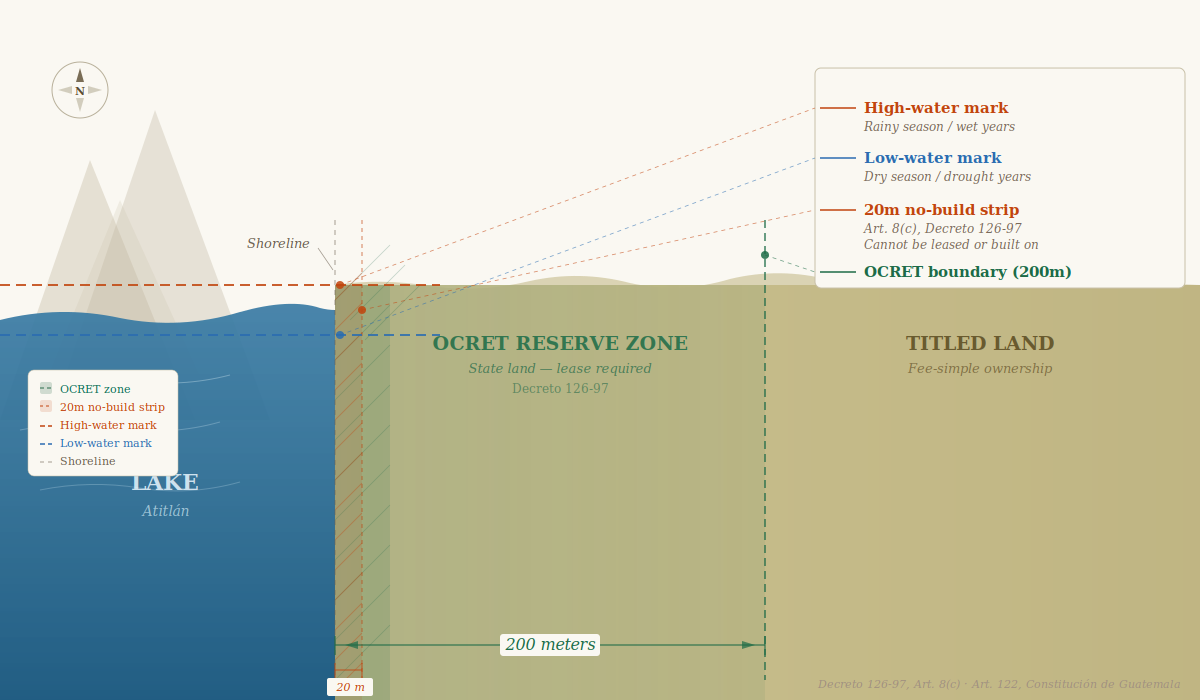
The OCRET reserve zone extends 200 meters from the surveyed shoreline. Within that zone, Article 8(c) of Decreto 126-97 prohibits leasing or building on the innermost 20-meter strip. Lake Atitlán's fluctuating water level means the shoreline on your contract may differ from what you see on the ground. Always design to the historic high-water mark.
If you are looking at lakefront property at Lake Atitlán, you are almost certainly looking at land within the OCRET zone.
Can a Foreigner Hold an OCRET Contract?
This is the question with the most confusing answers online, and the correct answer matters for how you structure your purchase. In practice at Lake Atitlán: foreigners cannot hold an OCRET contract in their personal name. The contract must be held by a Guatemalan Sociedad Anónima (S.A.) — a locally registered corporation — of which you are the shareholder.
This is not an unusual obstacle. Guatemala grants foreign nationals the same property rights as citizens for most real estate. But the OCRET leasehold framework, as administered in practice, requires a locally constituted legal entity as the contracting party. The S.A. structure is the standard vehicle used by international buyers throughout the lake, and it carries advantages that extend well beyond OCRET compliance: it simplifies estate planning, can hold multiple assets, and creates a clean, transferable structure for future resale — one that a sophisticated buyer can step directly into without reconstituting the legal framework from scratch. That continuity has real market value.
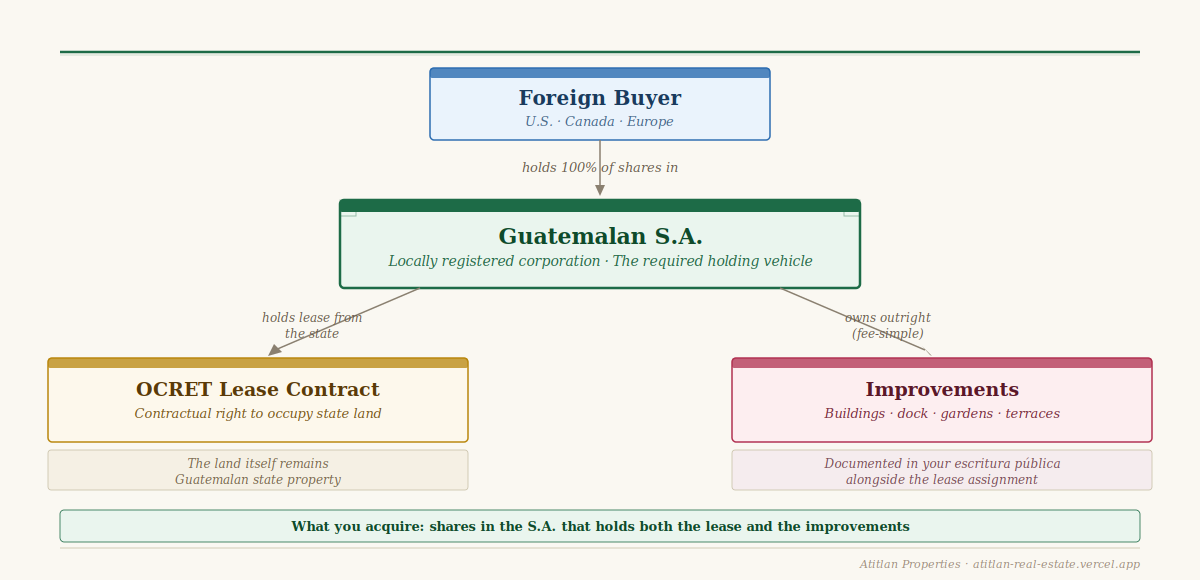
What you actually acquire: shares in the Guatemalan S.A. that holds both the OCRET lease and the improvements. The land itself remains Guatemalan state property.
A Guatemalan S.A. can be formed by a licensed attorney in a matter of weeks, and formation costs are modest relative to any meaningful property purchase. The concept to internalize is that what you are acquiring is the shares of the S.A. that holds the OCRET lease, along with ownership of the improvements — the buildings, landscaping, and structures — constructed on the leased land. The land itself remains state property; the lease gives you the contractual right to occupy and use it.
Lease Terms, Annual Fees, and What Happens If They Go Unpaid
OCRET leases are granted for fixed terms that vary by intended use. Residential leases run for a defined initial period with renewal rights. Commercial, tourism, and eco-tourism uses have different term structures. The critical point for buyers: verify the remaining term on any existing lease and confirm the renewal process before committing to a price.
Annual fees are calculated per square meter of leased area, based on the use classification in the contract. Article 10 of Decreto 126-97 sets the statutory fee rates. The table below shows what those rates produce for a representative 1,000 m² lakefront parcel, at today's exchange rate of approximately Q7.70 to the dollar:
| Use classification | Rate (Q/m²/yr) | Annual fee (Q) | Annual fee (USD ~) | Statutory source |
|---|---|---|---|---|
| Tourism / ecotourism | Q 0.75 | Q 750 | $97 | Art. 10(c), Decreto 126-97 |
| Residential — vacation / recreation | Q 1.00 | Q 1,000 | $130 | Art. 10(a), Decreto 126-97 |
| Industrial / commercial | Q 1.75 | Q 1,750 | $227 | Art. 10(b), Decreto 126-97 |
These are statutory floor rates from the law itself. OCRET's current fee schedule (Decreto 101-97) may produce higher amounts for specific parcels. Confirm current rates with your attorney before closing. For most lakefront residential and tourism properties, the annual fee is modest relative to the value of the asset — often less than a single night's rental income.
Non-payment has precise consequences. If fees fall more than six months into arrears, OCRET issues a formal payment demand giving the leaseholder 30 days to cure the default. If payment is not made within that window and no payment arrangement is agreed, OCRET issues a resolution rescinding the contract. The property reverts to direct state control, and OCRET initiates an eviction process through the Attorney General.
Before closing on any OCRET property, your attorney must obtain a direct records confirmation from OCRET that all annual fees are current and the contract is in good standing.
Can an OCRET Lease Be Transferred When a Property Is Sold?
Yes — but not automatically, and not without OCRET's explicit approval. The transfer of an OCRET lease (cesión de derechos de arrendamiento) requires a formal application to OCRET, submitted by both the seller and the buyer. Under the updated 2024 regulations, this application can now be filed digitally, which has improved the timeline somewhat, but it remains a substantive administrative step.
Required documentation includes proof of the transfer, updated property survey plans, and identification of the incoming legal entity — the buyer's Guatemalan S.A. A financial guarantee (fianza) is now formally required from the incoming leaseholder to cover the remaining contract term, unless the buyer elects to prepay all remaining annual fees at the time of transfer. This requirement was codified more explicitly under the 2024 regulation and should be factored into closing costs.
An OCRET lease transfer adds time and legal work to your closing process that a conventional titled-property transaction does not. Your attorney and the seller's attorney need to coordinate the OCRET filing alongside — not after — the main property conveyance. Buyers should budget for this additional step and not assume that the closing timeline mirrors a standard freehold transaction.
One important structural note: the improvements on the property — buildings, docks, gardens, terraces — are sold through a separate instrument from the lease assignment. In practice, both are formalized in the same escritura pública before a notary, but they are legally distinct transactions. Both must be properly documented in your closing package.
A Note on Installment-Based Purchases
Article 26 of Decreto 126-97 requires the buyer to present a completed public deed — an escritura pública — before OCRET can register the lease assignment. In a purchase structured with deposit payments over months or years, which is common at Lake Atitlán, that escritura typically is not executed until the final payment is made. The practical consequence: you are not the OCRET leaseholder of record until the very end of the payment schedule, regardless of how much you have paid in. This is not unusual and not necessarily a problem, but it needs to be addressed explicitly in your purchase agreement from the start — including provisions that protect the buyer if a dispute arises before final payment.
There is no formal mechanism to file a preliminary OCRET application based on a promesa de compraventa alone. What experienced attorneys do in practice is use the installment period productively: gathering required documentation, verifying survey plans, confirming fee status, and preparing the full transfer package so that everything is staged and ready to file the moment the final escritura is signed. The transfer still cannot be registered until that point, but the administrative delay after closing can be compressed significantly with proper preparation. If you are making an installment-based offer on an OCRET property, ask your attorney specifically how they plan to manage the transfer timeline — and make sure the answer is a concrete plan, not a general reassurance.
Building Rights Within the Reserve Zone
Holding an OCRET lease does not give you unlimited development rights on the leased land. The law, OCRET's own authorization process, and the realities of the lakefront impose meaningful constraints on what can be built and where. Buyers planning to develop or renovate a lakefront property at Lake Atitlán need to understand these constraints before finalizing their plans — and certainly before agreeing on a price.
The 20-Meter No-Build Strip
Article 8(c) of Decreto 126-97 establishes an absolute prohibition on leasing or building within 20 meters of the lake waterline. OCRET cannot grant a lease on this innermost strip, and no structures can be built there. The practical effect is the same as a mandatory construction setback: regardless of what your OCRET contract surveys, the first 20 meters from the water belong to the state and must remain unbuilt. This applies to docks and permanent waterfront structures as well, which require separate authorization from OCRET.
This strip also serves as the public-use buffer that prevents private development from blocking lakeshore access. Any structure that encroaches on it — even one that has existed for years — is not legally compliant and can complicate future lease transfers.
Atitlán's Unique Building Constraint: Lake Level Fluctuation
Lake Atitlán's water level fluctuates — sometimes significantly — between the dry season and the rainy season, and across longer multi-year cycles. The 1976 earthquake alone caused the lake to drop two meters in a single month. This creates a genuine building complexity specific to Atitlán: the shoreline shown on your OCRET contract's survey plan may not match the actual shoreline on the day you build, or the day a buyer tours the property five years from now.
Any new construction on an OCRET lakefront parcel should be designed to the historic high-water mark, not to the current or average shoreline.
A competent local architect who understands the lake's hydrological patterns is not optional — it is the difference between a well-sited structure and a very expensive mistake. This is one of the reasons our affiliated design-build practice treats site acquisition and the design process as a single integrated decision, not two sequential ones.
Two Separate Approvals: Municipal Permit and OCRET Authorization
Any construction within the OCRET reserve zone requires two independent approvals running in parallel: a building permit from the relevant municipalidad, and direct authorization from OCRET for construction activity on the leased land. Neither substitutes for the other. Projects with a municipal permit but no OCRET authorization — or vice versa — are not legally compliant, and unpermitted structures can complicate or outright block future lease transfers. Factor both processes into your construction timeline.
What About Lakefront Properties Without an OCRET Contract?
This is where the Lake Atitlán market becomes particularly complex. A significant share of lakefront properties at Atitlán operate without formal OCRET contracts — occupants hold either informal right of possession (derecho de posesión) or titled land that predates 1956, which is constitutionally exempted from the reserve requirement. As noted above, OCRET has formally registered less than 10% of the land under its national jurisdiction.
A lakefront property without an OCRET contract is not automatically illegal — it may be operating in a gray zone that has existed for decades. But it carries real risks: OCRET enforcement is increasing, the 2024 regulatory overhaul signals a clear institutional direction toward expanded compliance, and an unlicensed lakefront property is harder to sell to a sophisticated buyer and very difficult to finance through any institutional channel.
If you are considering a property within the 200-meter zone that does not yet have an OCRET contract, the right question is not whether to ignore the issue — it is whether the path to regularization is clear, feasible, and completable before or at closing. Evaluating that distinction accurately requires an experienced local attorney and a broker with enough transaction history to know which situations are solvable and which ones are not.
Frequently Asked Questions
What is the difference between an OCRET property and a titled property at Lake Atitlán?
A titled property (finca registrada) has fee-simple ownership registered in Guatemala's national property registry. An OCRET property is a government lease — you hold the contractual right to occupy and use state land, and you own the improvements on it. Both types transact regularly at Lake Atitlán; the due diligence processes are simply different.
Can I own lakefront property at Lake Atitlán as a foreigner?
Yes. Guatemala grants foreign nationals the same property ownership rights as citizens. For most real estate, including titled properties, you can hold directly in your own name. For OCRET leasehold properties, the practical and legal structure is to hold the contract through a Guatemalan S.A. of which you are the shareholder.
What happens to an OCRET lease when a property is sold?
The lease does not transfer automatically. Both seller and buyer must submit a formal lease assignment application (cesión de derechos) to OCRET for review and approval. All outstanding fees must be current before OCRET will approve the transfer. The process requires a completed escritura pública before it can be filed, which matters particularly in installment purchases — the formal transfer cannot be registered until the final payment is made and the deed is executed.
How do I verify a property's OCRET status before buying?
Your Guatemalan attorney must obtain a direct records confirmation from OCRET confirming: (1) an active contract exists in the seller's S.A.'s name; (2) all annual fees are paid to current date; (3) the lease term and renewal status; and (4) any outstanding OCRET notices or enforcement actions. This verification is foundational — it should occur before you agree on a purchase price, not after.
What is the annual OCRET fee and what happens if it is not paid?
Annual fees for lakefront residential and tourism properties at Lake Atitlán run from approximately Q750 to Q1,750 per year for a 1,000 m² parcel, depending on use classification — translating to roughly $97 to $227 USD at current exchange rates. Larger parcels pay proportionally more. If fees fall more than six months overdue, OCRET issues a formal 30-day cure notice. If the default is not cured, the contract is rescinded and the property reverts to state control.
What is right of possession and how does it differ from an OCRET lease?
Right of possession (derecho de posesión) is an informal occupancy claim based on long-term use of land — widespread in Guatemala and common at the lake, particularly in Maya communities. It is not an OCRET contract. A property held by right of possession within the 200-meter zone is legally exposed: the occupant has no formal lease, and the state's claim to the underlying land is unresolved. These properties can sometimes be regularized, but the path is complex and not guaranteed.
OCRET Is Manageable — With the Right Team
OCRET is not a reason to avoid lakefront property at Lake Atitlán. The most spectacular properties at the lake — the ones with genuine water frontage, private docks, and unobstructed views — are almost all OCRET-leased. The structure is workable when you understand it and have the right legal and brokerage team around you from the beginning.
The buyers who encounter problems are almost invariably the ones who treated OCRET as a closing detail rather than a foundational input to deal structure.
At Atitlan Properties, OCRET status verification is built into every buyer engagement we conduct. If you are evaluating a lakefront property and want a clear, honest read on what you are actually buying — the lease terms, fee status, building constraints, and transfer path — reach out. That clarity is what we are here to provide.
Sources & References
Constitución Política de la República de Guatemala, Artículo 122
Decreto 126-97, Ley Reguladora de las Áreas de Reservas Territoriales del Estado de Guatemala — Articles 8(c), 10, 26
Acuerdo Gubernativo 151-2024, Nuevo Reglamento de la Ley Reguladora (en vigor desde 1 de octubre de 2024)
OCRET — Marco Legal: https://ocret.gob.gt/marco-legal/
Stefan Bird, Atitlan Properties — market knowledge, transaction experience, and on-the-ground practice at Lake Atitlán
This post is educational in nature and does not constitute legal advice. Consult a licensed Guatemalan attorney for guidance specific to your transaction.